Michael J. Fox Net Worth 2025: How the Back to the Future Icon Built His $65 Million Legacy
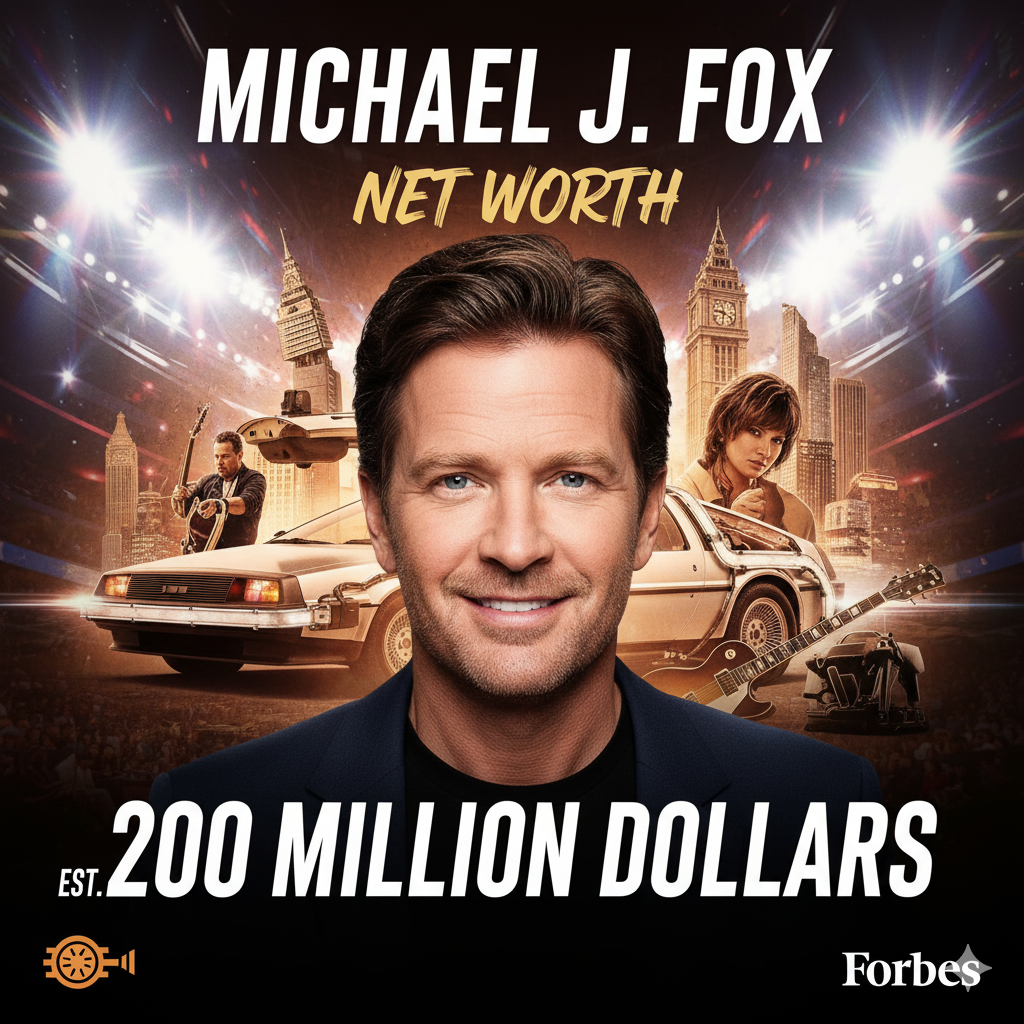
Michael J. Fox has that timeless spark—the kind that lights up a screen and warms a room, turning everyday folks into lifelong fans. Whether he’s zipping through time in a DeLorean or sharing raw truths about living with Parkinson’s, Michael’s blend of charm, wit, and grit has made him a Hollywood treasure. As of October 2025, Michael J. Fox’s net worth is a cool $65 million, a fortune that’s as enduring as his smile despite the health battles he’s faced head-on. This isn’t just about the money; it’s the story of a Canadian kid who hustled from soap operas to sitcom stardom, then pivoted from personal pain to global advocacy. From “Family Ties” family dinners to foundation fundraisers, Michael’s journey shows how talent, timing, and tenacity can build something lasting. In this easygoing chat, I’ll walk you through his early days, the roles that raked in the dough, and how he’s turning wealth into wellness. If you’re a ’80s kid at heart or inspired by comeback kings, grab a flux capacitor—let’s time-travel through his incredible ride.
Early Life: From Edmonton Winters to Hollywood Dreams
Michael Andrew Fox (he added the “J” for his stepdad, Jay) was born on June 9, 1961, in Edmonton, Alberta, Canada, the youngest of five kids in a military family. His dad, Bill, was a Royal Canadian Regiment sergeant major, moving the clan around bases from Newfoundland to California. Life was nomadic but full of laughs—Michael’s mom, Phyllis, a payroll clerk, kept the home humming with card games and storytelling. By age 10, the family settled in Burnaby, British Columbia, where young Michael discovered his stage legs at summer camp, mimicking stars like John Wayne.
School? A breeze for the brainy kid—he skipped grades and dreamed big, but acting called louder than algebra. At 15, he landed his first pro gig on CBC’s “Leo and Me” (1976), playing a street-smart teen. “It felt like home,” he later said. By 18, Michael dropped out of high school (finishing his diploma via correspondence) and headed to L.A. in 1979 with $5 in his pocket and a one-way Greyhound ticket. Early days were rough: Crashing on couches, auditioning endlessly, and scraping by on bit parts like “Palmerstown, U.S.A.” (1980). No nepotism boost here—just raw talent and relentless drive. Those lean years built his humility, turning a wide-eyed teen into a pro ready to seize the spotlight.
Also Check:- A’ja Wilson Net Worth 2025: How the WNBA Superstar Built Her $4 Million Empire
Breakthrough Roles: “Family Ties” and the “Back to the Future” Magic
Michael’s rocket launch hit in 1982 with “Family Ties,” NBC’s Reagan-era sitcom where he played Alex P. Keaton, the yuppie kid in a hippie family. It was lightning in a bottle—originally a side character, producers bumped him up after his charm stole scenes. Airing until 1989, the show averaged 20 million viewers, earning Michael three Golden Globes and four Emmys (including Outstanding Lead Actor in 1986-1989). Pay? Starting at $25,000 per episode, it climbed to $200,000 by the end—totaling $10-15 million over seven seasons, plus syndication residuals that still trickle in.
Then, 1985’s “Back to the Future” sealed his icon status. As Marty McFly, the skateboarding teen flung to 1955, Michael beat out Eric Stoltz (fired after weeks) and grossed $381 million worldwide. His $500,000 salary was modest, but sequels (1989’s Part II and 1990’s Part III, each $350+ million) added $5 million more. The trilogy’s merch—posters, lunchboxes, games—poured in royalties, while theme park rides and reboots keep the cash flowing. These roles weren’t just hits; they were cultural touchstones, turning Michael from TV darling to movie megastar overnight.
Career Evolution: From “Spin City” to Selective Spotlights
The ’90s brought “Spin City” (1996-2000), ABC’s political comedy where Michael played deputy mayor Mike Flaherty. It was Emmy gold again (Lead Actor wins in 2000), with 10 million viewers and a $225,000-per-episode payday—netting $4-5 million total. Health whispers started in 1998 (he’d been diagnosed with Parkinson’s in 1991 at 29), but Michael powered through, hiding tremors with clever camera tricks.
Post-2000 retirement from full-time acting, he shifted to voice work and cameos: “Stuart Little” (1999-2005) as the mouse dad ($1-2 million across films), “Atlantis: The Lost Empire” (2001), and “The Magic Roundabout” (2005). TV pops like “Rescue Me” (2004) and “Curb Your Enthusiasm” (2009) added $100,000-$200,000 each. In 2023, his Apple TV+ doc “Still” revisited his life, earning critical acclaim and a $1 million+ deal. By 2025, Michael’s selective—guesting on “Shrinking” Season 3 with Harrison Ford, blending laughs with lived wisdom. It’s not volume; it’s impact, keeping his earnings ticking at $2-3 million yearly from residuals and specials.
| Project | Years | Role | Estimated Earnings |
|---|---|---|---|
| Family Ties | 1982-1989 | Alex P. Keaton | $10-15 million |
| Back to the Future Trilogy | 1985-1990 | Marty McFly | $6-8 million |
| Spin City | 1996-2000 | Mike Flaherty | $4-5 million |
| Stuart Little Series | 1999-2005 | Voice of Stuart | $1-2 million |
| Books & Docuseries | 2002-2025 | Author/Subject | $3-5 million |
These gems show how timeless roles fuel lasting wealth.
Parkinson’s Journey: Turning Pain into Purpose
Life threw Michael a curveball in 1991: Diagnosed with young-onset Parkinson’s at 29, just as fame peaked. He kept it secret for seven years, using hats and scripts to mask tremors, but went public in 1998 with grace. “It sucks, but it’s mine,” he quipped. Retirement followed in 2000, but Michael didn’t fade—he fought back.
In 2000, he launched the Michael J. Fox Foundation for Parkinson’s Research (MJFF), pouring $2 billion+ into trials by 2025—discovering genes, funding stem cells, and trialing therapies. It’s raised awareness too: His 2010 book “A Funny Thing Happened on the Way to the Future” and 2020’s “No Time Like the Future” became bestsellers, earning $1-2 million each. The 2023 doc “Still” added $1 million+, blending humor with hope. Advocacy? He’s testified before Congress, starred in awareness PSAs, and golfed for galas, netting speaking fees ($50,000+). Parkinson’s slowed him—falls, surgeries, memory fog—but amplified his voice, turning vulnerability into a $65 million legacy of impact.
Also Check:- Zayed Military Hospital Nurse Salary Guide 2025: What to Expect in the UAE
Personal Life: Family, Faith, and Quiet Joys
Michael’s no solo act. He met actress Tracy Pollan on “Family Ties” in 1985—sparks flew mid-scene—and they wed in 1988, defying Hollywood odds with 37 years strong. Their four kids—Sam (born 1989), twins Aquinnah and Schuyler (1995), and Esmé (2001)—are his anchors. “Tracy’s my hero,” he says; she’s produced his docs and stood by through 50+ surgeries. The family splits time in New York and the Hamptons, with Michael’s $10 million Manhattan townhouse (bought 1996) as home base.
Faith? Michael’s spiritual but private—drawing from Judaism (Tracy’s heritage) and humanism. Hobbies? Golf (he’s a scratch player), guitar jams, and dad jokes with the grandkids. At 64, he navigates with humor: “Parkinson’s is the world’s slowest thief,” but adds, “I’m still stealing the show.”
Challenges and Resilience: The Man Behind the Smile
Michael’s had heartbreaks: Hiding his diagnosis amid “Spin City” exhaustion, public scrutiny post-reveal, and the disease’s toll—deep brain stimulation in 1998, spinal surgery in 2022. Family? The 2018 fires threatened their wine country home. Yet, resilience defines him: “Acceptance isn’t surrender,” he writes in “Lucky Man” (2002, $1 million+ sales). Therapy, Tracy’s support, and MJFF’s wins keep him swinging.
Final Thoughts
Michael J. Fox’s $65 million net worth in 2025 is more than residuals—it’s a testament to turning trials into triumphs. From Marty McFly’s flux to foundation breakthroughs, he’s shown fame’s fleeting but fight’s forever. As “Still” inspires and his fifth book “Future Boy” drops October 14, Michael’s legacy glows brighter than any marquee. What’s your favorite Fox flick? Share below—let’s keep the time-travel talk going.